The Reporting feature is part of the Dashboard feature and allows you to configure how your dashboards are synced. Reporting Services are a hosted solution and to function, Application Workspace requires internet access.
The Standard license (included in Application Workspace) will only allow the Reporting feature to work based on the last 2 months of data.
This feature is currently in preview.
Since it is a hosted solution, certain data of applications used by customers is collected as described in Section C of the Data Protection Information and in accordance with our privacy statement.
It can take up to 24 hours before new data is available.
The following options are available:
Status - Describes the status of the Reporting Service:
- Unconfigured - is not enabled for the local zone.
- Disabled - is disabled for the local zone. Contact the support department for more information.
- Configured - is configured for the local zone but has not been synchronized yet. It can take up to 24 hours for the first synchronization to occur.
- Warning - Data has been synchronized but not completely. See the Result field for more information.
- Failed - An error occurred while synchronising with the local zone. See the Result field for more information.
- Synchronized - Data has been synchronized with the local zone.
Result - This can be a warning or an error message which describes what error occurred during the previous synchronisation. It is displayed only if an error occurs.
External URL - The URL which should be used by the cloud solution to access the Application Workspace Server. Typically, it is your FQDN.
Synchronized at - The last time the data from Application Workspace was synchronized with the dashboards. Data is synchronized within an interval of 24 hours.
Test connectivity button - This button becomes available after the zone is configured for reporting. The external connectivity can be verified by clicking on this option, which will initiate a remote connection request to the local zone and verify that everything is set up correctly.
Firewall prerequisites
If you have a firewall in place that filters the communication between the local Application Workspace System and the Application Workspace Reporting Services, you must configure the following settings in order for the Reporting feature to work properly.
Inbound rules
| DNS | Port |
|---|---|
| report-service.liquit.com | 443 |
| report-service-outgoing.liquit.com | 443 |
Outbound rules
| DNS | Port |
|---|---|
| report-service.liquit.com | 443 |
Using the Power BI Template for enhanced reporting
Since Application Workspace version 4.4, we’ve made a new Power BI template available as an alternative to the built-in Reporting functionality. This template is hosted externally and is not yet integrated into the Application Workspace. Although it currently provides access primarily to events data, the new template significantly expands reporting capabilities by offering greater granularity and a wider range of insights—including licensing, deployments, launch health, install health, and more.
License
The new Power BI template is supported for all three licence types: Standard, Access Manager and Release and Patch Management.
Data window
The new Power BI template allows you to retrieve data directly from the software database, without relying on a data window.
Download
You can download the Power BI template from the Integrations section of our downloads website.
Generating the username and password in Application Workspace for the Power BI Template
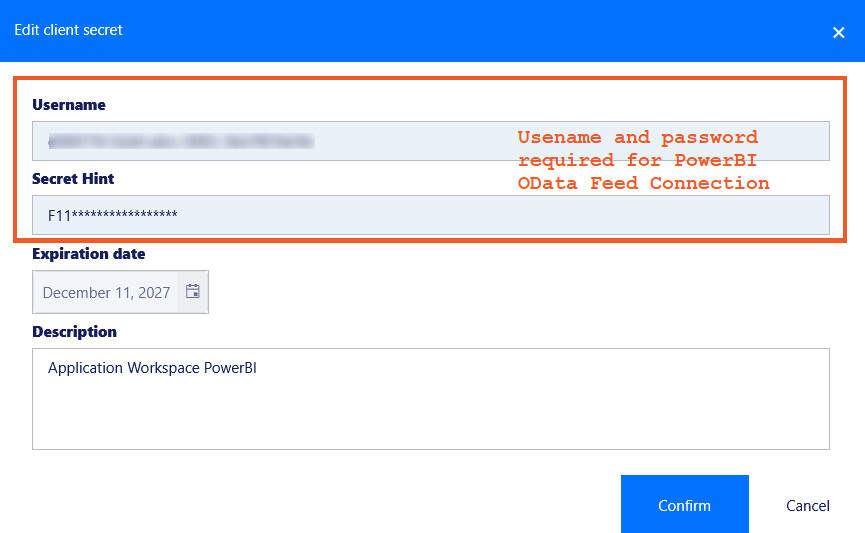
To configure the OData Feed Connection for the Power BI template, you must first create a username and password in Application Workspace.
- Navigate to: Manage > System > API Access.
- Click
 in the table toolbar.
 - In the Create client secret dialog box:
- Write a description.
- Specify an expiration date. By default, the field is prefilled with a date two years from today. If left blank, the expiration will be set to Never.
- Click Finish in the Summary screen, to generate the client secret.
- A confirmation dialog, Your client secret has been created, will appear. This contains the password for the Power BI OData Feed Connection.
- Find the username:
- The username becomes available after the client secret is created, so you need to open the newly created client secret to view the username.
- Note that the username is a static value, unique per zone.
For more information, see API Access.
Power BI tools
The .PBIT template can be uploaded to any of the Power BI tools that supports publishing the template to an on-prem Power BI Report Server: Power BI Desktop (Optimized for Power BI Report Server), Power BI Service, and Power BI Report Server.
We recommend Microsoft Power BI Desktop 2.147.1088.0 64-bit (September 2025) (Optimized for Power BI Report Server).
Configuring the OData Feed Connection
- After you open the Power BI tool, just open the template and you will be prompted to insert the Zone URL. The format of this URL is
https://<virtualhost>/api/reports/v4/ - Next, in the Basic screen you have to enter the username and password you generated in Application Workspace, described at Generating the username and password in Application Workspace for the Power BI Template.
- We recommend keeping the prefilled level of authentication as-is. Changing this setting has no impact on the connection or data access.